Automating the digital claims experience
Creating faster decisions, clearer guidance, and measurable efficiency gains
Context
The goal was to reduce operational inefficiencies, simplify a complex journey, and incorporate automation for the first time, by redesigning the claims journey for a large private medical insurance organisation.
The problem
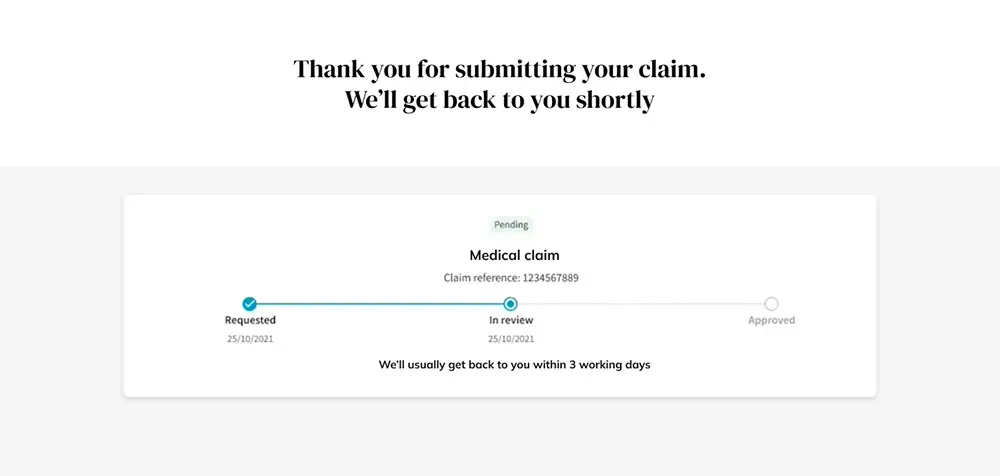
Digitally, customers waited days for eligibility decisions, while telephony customers often received answers immediately.
At the same time:
- Customers felt lost in the end-to-end healthcare journey
- Insurance terminology created confusion and anxiety
- Agents manually re-keyed unstructured data
- Expectations of “fast private care” often clashed with reality
As well as a speed issue, this was a clarity and confidence problem
Research and discovery
We ran:
- Multiple rounds of qualitative interviews
- Quantitative journey testing
- Customer workshops
- Analytics deep dives
Key insight
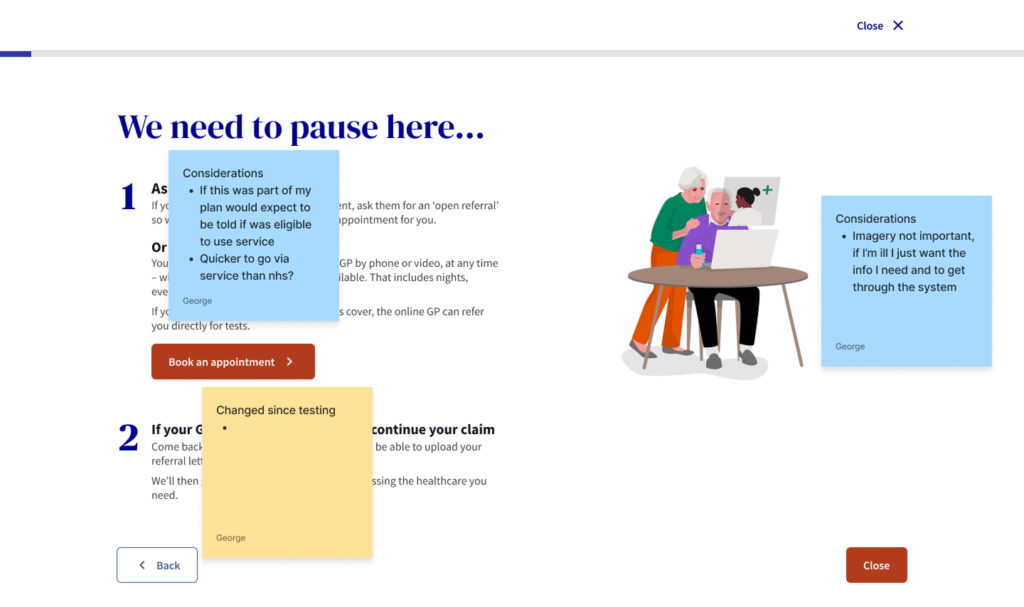
- Plain language
- Step-by-step guidance
- Status visibility
- Reassurance during vulnerable moments
Defining the opportunity
Using recurring themes from the customer feedback programme, I helped define a focused strategy:
Design principles:
- Customer in control
- Proactive guidance
- Sensitivity to context
- Seamlessly connected systems
- Plain, human language
We aligned around measurable outcomes:
- Reduced eligibility turnaround times
- Improved satisfaction and experience metrics
- Operational efficiency gains
- Increased adoption of alternative care pathways
- Improved claims data visibility
Navigating constraints
This project operated within:
- Regulatory requirements
- Complex legacy systems
- Third-party integrations
- Tight delivery timelines
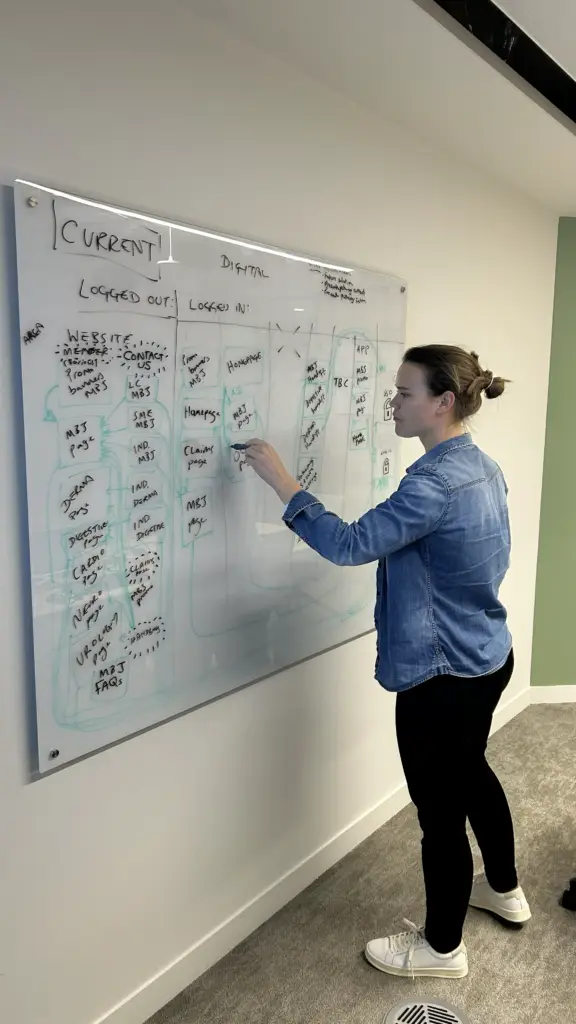
A turning point came when we mapped technical constraints early, allowing us to design phased, achievable improvements rather than idealised but unfeasible concepts.
From complexity to clarity
Early exploration included:
- Automated eligibility checks
- Condition-specific pathways
- Data integrations for capacity insights
To accelerate delivery, we reduced initial complexity and created a structured question-based flow that:
- Routed customers accurately
- Reduced ambiguity
- Laid groundwork for future automation
Edge cases were workshopped with subject matter experts to ensure safety and compliance.
I also contributed new components and behavioural rules to the design system to support scalability.
Collaboration and influence
- Brought the user voice into stakeholder rooms through interview playback videos
- Advocated for dedicated research time in roadmap planning
- Identified areas requiring clinical and specialist support early
- Helped split the initiative into two focused product areas to accelerate progress
- Influenced communication strategy and third-party collaboration practices
Prototyping became a key alignment tool, reducing ambiguity across engineering, architecture, and business teams.
Impact
The redesigned journey delivered:
- Operational savings equivalent to several full-time operational days per month
- Reduced average eligibility turnaround time
- More than doubled adoption of alternative care pathways
- Increased data structure and visibility
- Improved customer and agent satisfaction
More importantly, it established a scalable foundation for future automation.
More featured work

Services content strategy
Reimagining the content strategy for online health services